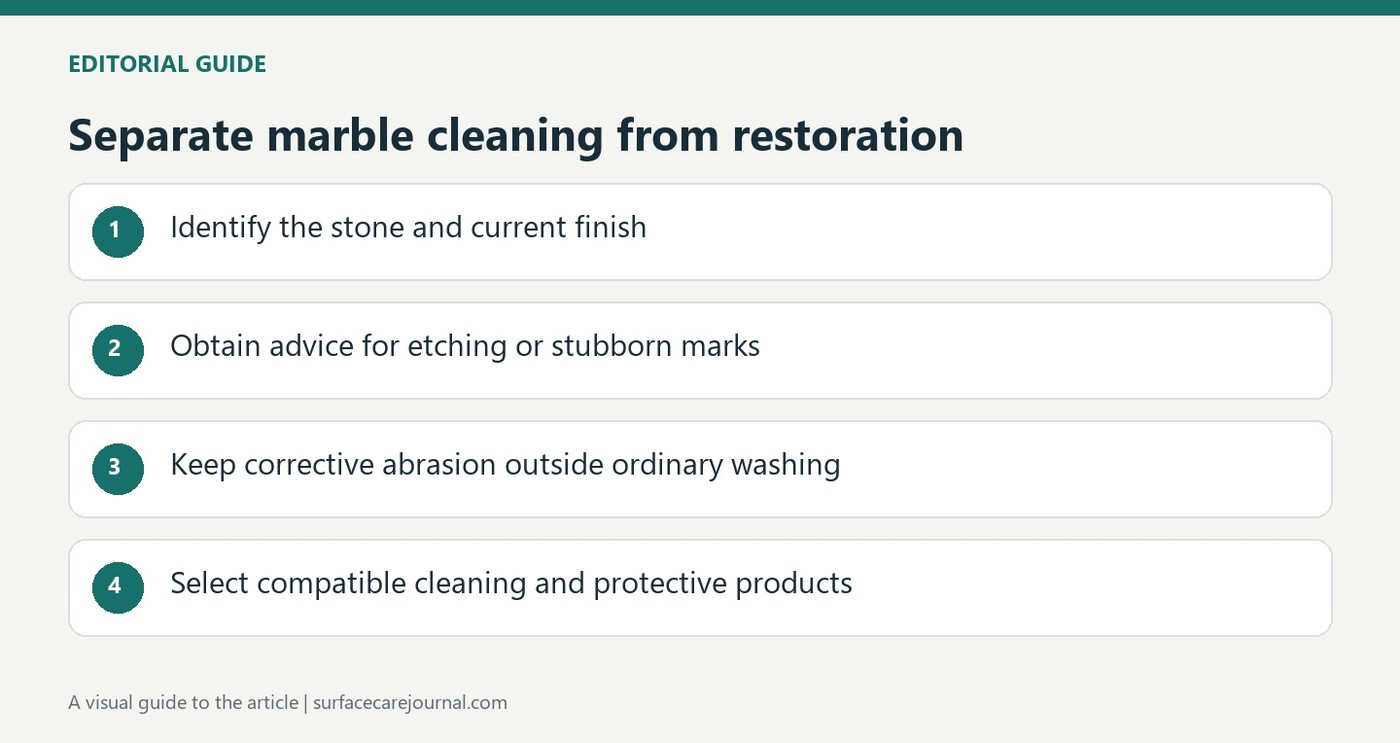
Separate Marble Restoration from Ordinary Counter Care
The Martha Stewart marble reference discusses advice sought from stonemasons alongside stone-specific cleaning and sealing products. It also mentions more intensive treatments involving solvents and fine abrasives. Those interventions concern the particular surface and its restoration needs.
Do not assume sanding or solvent use belongs in routine marble care. Check the stone and finish, and seek specialist guidance where marks require correction. Everyday gentle cleaning, targeted stain work, and protective sealing serve different purposes and need different decisions.
Read the account as a particular restoration example
Homes and Gardens reports Martha Stewart consulting Mark Galazzo of Precision Stone about her own kitchen counter. The reported sequence includes clearing the surface, solvent wiping, wet abrasive work, a stone cleaner and a sealer. Those details describe that counter and the advice obtained for it. They do not demonstrate that another marble slab, existing coating or polished finish should receive the same treatment.
Recognize why the abrasive stage changes the task
The article describes using waterproof 400 grit paper to address etching. That is surface correction rather than ordinary removal of crumbs or cooking splashes. Abrasive work can change the appearance of a finish, while acetone is a flammable solvent with its own handling requirements. Obtain stone-specific professional guidance before considering either step, rather than turning a reported celebrity maintenance process into a daily kitchen recipe.

Keep cleaning and protection as separate decisions
The account uses StoneTech Revitalizer for cleaning and StoneTech BulletProof Sealer afterward. These product names help explain the reported process, but each product must be appropriate for the actual stone and used according to its own label. Stock clean cloths and remove residue thoroughly. A successful appearance on Stewart's long-used counter is an anecdotal outcome, not a guarantee that the same sequence will remove every mark elsewhere.
Keep the reported counter and professional advice in view
Homes & Gardens recounts Martha Stewart obtaining advice from Mark Galazzo of Precision Stone for her own kitchen counter. That consultation is an essential part of the story, because it connects the reported treatment to a particular stone, finish and maintenance history. The account is useful as an example of seeking stone-specific help, rather than proof that a reader's different countertop should receive the same sequence.
The reported kitchen surface had been used for many years and served several everyday roles. Its eventual appearance is an anecdotal result on that counter, not a controlled comparison across marble types or coatings. Before borrowing any stage, identify the installed stone, the cause of the marks and the intended finish. Ordinary food residue and a surface affected by acid are different reasons for choosing a method.
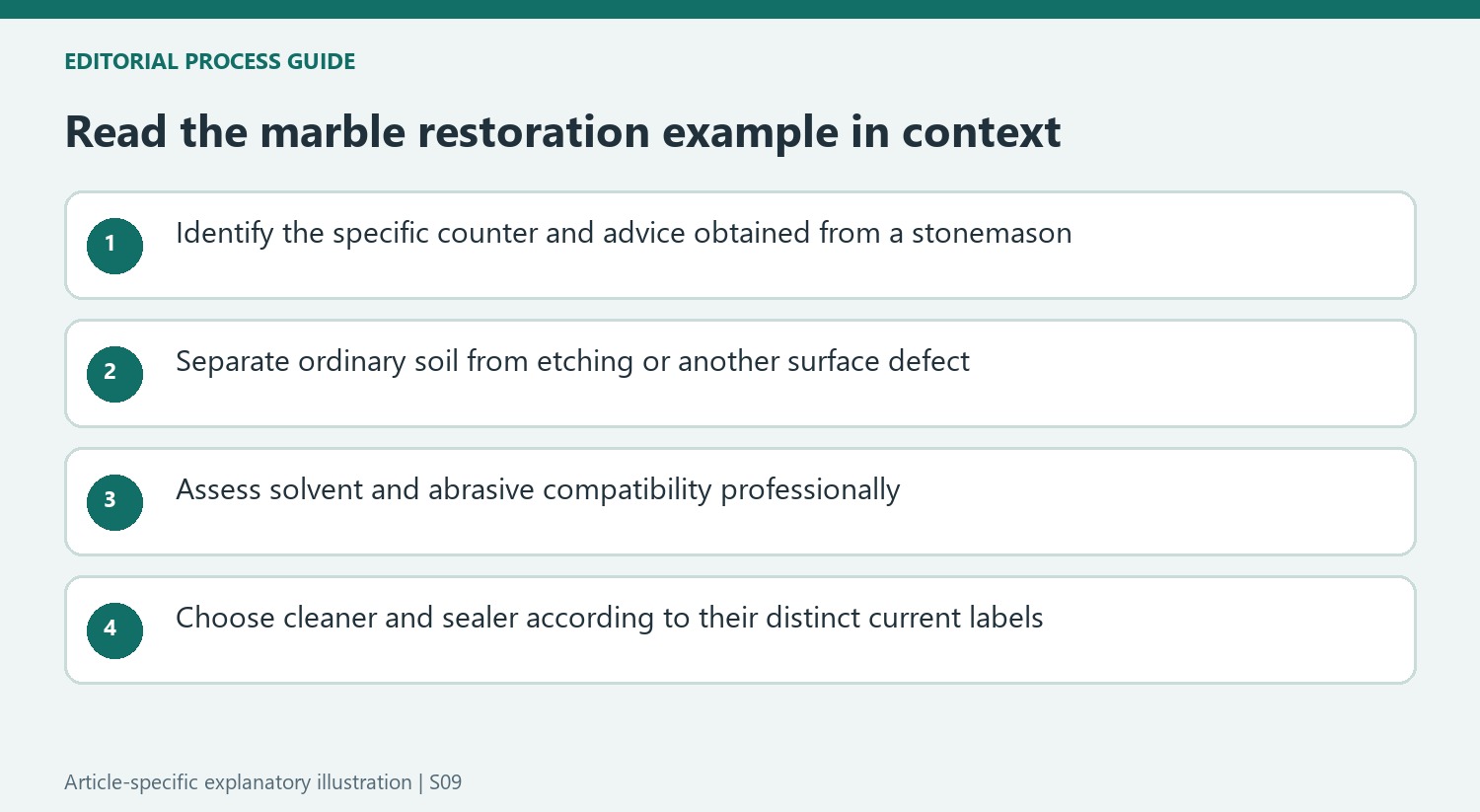
Recognize the point where wiping becomes restoration
The article describes acetone wiping and wet work with waterproof abrasive paper. Both are different from a daily mild wash: solvent compatibility and flammable-liquid handling require specific instructions, while abrasion changes the surface being repaired. The fact that a fine abrasive was successful in the reported process does not establish that water prevents scratching on every marble finish. Do not convert the account into an unqualified household procedure.
Ask a stone professional how a proposed correction will blend across the affected area and what existing treatments may be disturbed. A localized dull patch could become more noticeable if its surrounding sheen is altered unintentionally. Knowing the entire repair plan before starting is more useful than buying the same grit of paper and hoping the rest of the surface will match afterward.
Separate the named cleaner from the named sealer
StoneTech Revitalizer and StoneTech BulletProof Sealer appear as distinct products in the reported sequence. Their presence explains the example but does not make them interchangeable, nor require both on every counter. Consult the exact current labels and the stone supplier for suitability, application, removal of excess and drying. A named commercial bottle still needs the same product-specific assessment as a less familiar stone-care treatment.
Clean cloths and complete residue removal remain useful lessons without adopting the restoration stages. Establish a gentle daily routine for the actual counter, then treat stain correction or sealing as separate decisions when needed. Do not infer disinfection or permanent protection solely from the source's description of an attractive final result. The strongest transferable point is the combination of material-specific assessment and a deliberate full process, with each stage chosen for the surface being treated.
References
- The Martha Stewart–Approved Method to Keep Marble Counters Sparkling – I’ll Never Use Another Way Again. Homes and Gardens; Martha Davies.
A specialist-led treatment should not be copied as a daily cleaning routine.


Leave a Comment
Comments (0)