
Test a Mild Approach Before Escalating Water-Ring Removal
Real Simple recommends a hidden-area check and separates surface treatment from sanding and refinishing.
Use the color as an initial clue
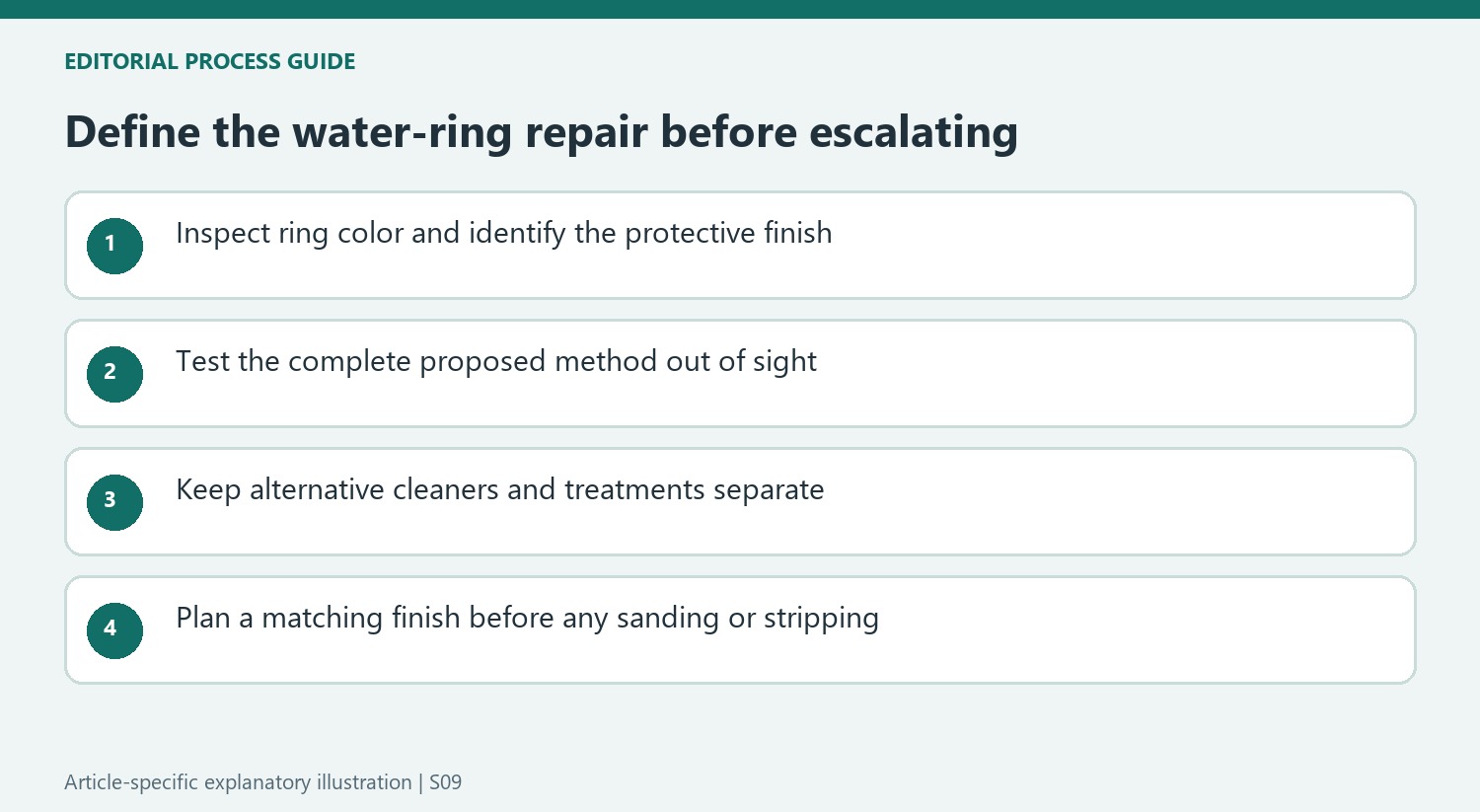
Real Simple distinguishes white water marks near the surface from darker stains that have penetrated further. It recommends trying any treatment in a hidden place first so the attempted repair does not create a larger finish problem. Its discussion of pale marks includes oil-based approaches applied along the grain, given time to act and then buffed to remove excess. Results depend on the furniture and its existing coating.
Stop combining different remedies
For more deeply affected wood, the article moves into sanding, stripping and refinishing rather than presenting every stain as an easy wipe-away problem. It specifically cautions against mixing cleaning products, including bleach and hydrogen peroxide. Trying several substances together is not the same as carefully assessing one method. Once restoration becomes necessary, a matching protective finish is part of the work. Valuable or uncertain pieces merit professional advice before any irreversible alteration.
Plan the finish repair before sanding
The source explains that deeper water damage may require stripping or sanding followed by a new varnish, wax or oil matching the original surface. That means removal is only part of the job. Check the material thickness and existing finish before starting, especially on veneer where sanding allowance may be limited. Its hidden-area test applies to the proposed treatment, not just the stain color. Do not interpret a list of alternative chemicals as a recipe for combining them. Keep separate approaches separate and follow the exact product directions. If the repair area cannot be blended reliably into the surrounding piece, seek restoration advice before making an irreversible change.
Make the hidden test answer the relevant question
Real Simple recommends an inconspicuous trial before treating the visible mark. Use the intended product, tool and contact conditions in that trial, then inspect for a change in gloss or color after the area is cleaned and dry. A test that only checks whether a cloth leaves a scratch does not establish that a liquid or heat treatment is compatible. The complete proposed method is what needs to be assessed.
The source separates pale marks near the surface from darker staining extending farther into the material. Use that as a starting clue, while also identifying the existing finish and whether it is already worn. On an important antique or a piece with an uncertain coating, a specialist's assessment may be more valuable than a sequence of improvised tests. The objective is to avoid creating a second defect around the first one.
Keep alternatives separate while observing their effects
The article mentions oils, heat and mildly abrasive approaches for white marks, but these act in different ways and carry different implications for the coating. Do not interpret the range of options as a recommendation to combine them on a wet patch. Record what was used and remove residue according to the appropriate directions before judging the result. An oily appearance or changed reflection alone does not prove that moisture-related clouding has been resolved.
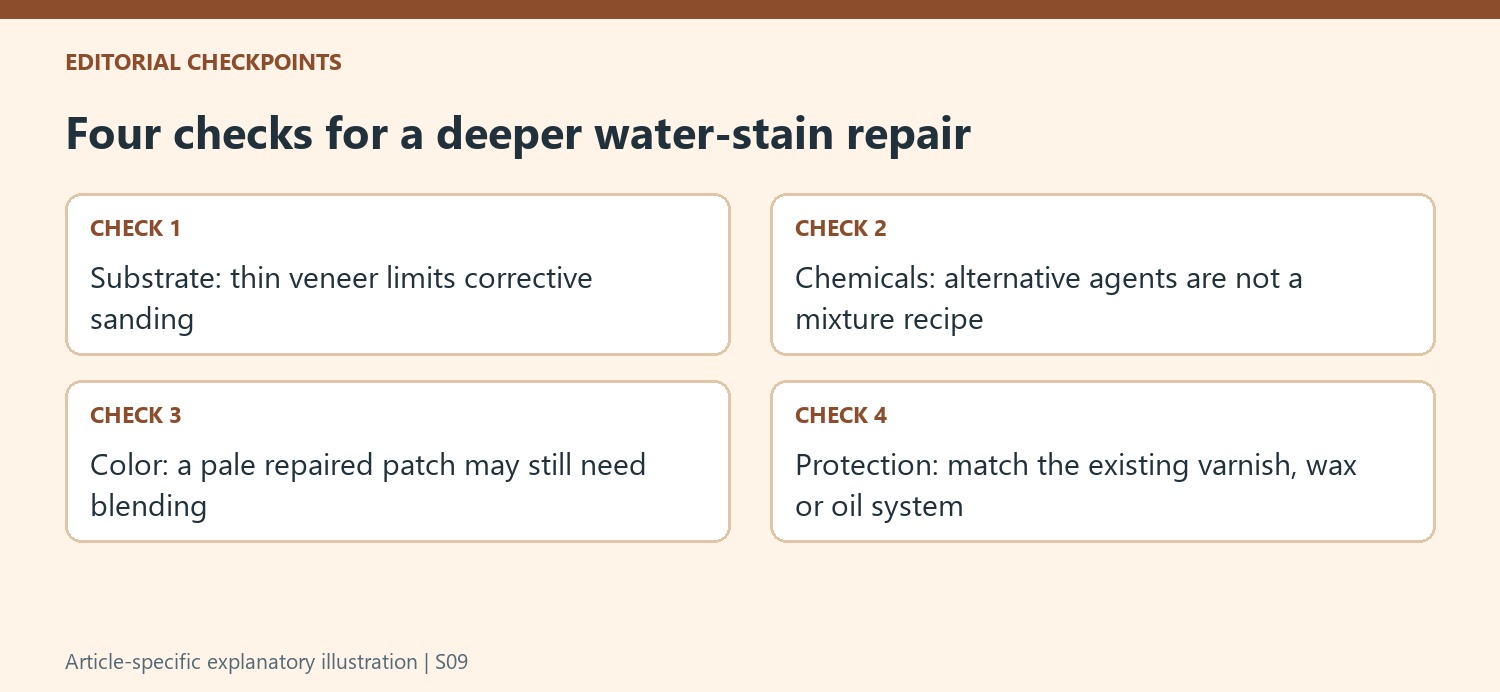
The same separation is even more important among the stronger products discussed for dark staining. The source explicitly warns against mixing cleaners, including bleach and hydrogen peroxide. Its list of possibilities should remain a list of distinct approaches, with current product instructions and material suitability checked independently. If a first treatment changes the finish or leaves uncertainty about residues, stop and seek guidance instead of escalating through the remaining options.
Consider the whole repair before exposing the timber
Sanding or stripping changes the furniture's protective surface, so plan the replacement finish before beginning that stage. Identify whether the piece is solid wood or veneered, how much material can safely be worked and whether a local color change can blend into the surrounding area. Removing a dark spot is not the complete result if the repaired patch is left conspicuously lighter or without appropriate protection.
Real Simple names varnish, wax and wood oil as possible matching finish situations. Those are different systems, so choose the one that corresponds to the actual piece rather than selecting whichever bottle is available. Follow its preparation, drying and service instructions. When the repair cannot be localized reliably, a restoration professional can advise on the scope, helping preserve the object rather than turning a limited water mark into a broader sanding experiment.
References
- Got Water Rings on Your Wood Furniture? Try These Easy Fixes First. Real Simple; Lisa Milbrand.
Real Simple recommends a hidden-area check and separates surface treatment from sanding and refinishing.


Leave a Comment
Comments (0)