Keep Strong Tarnish Methods Off Lacquered Brass
The Spruce separates gentle grime removal from treatment meant for suitable uncoated brass pieces.
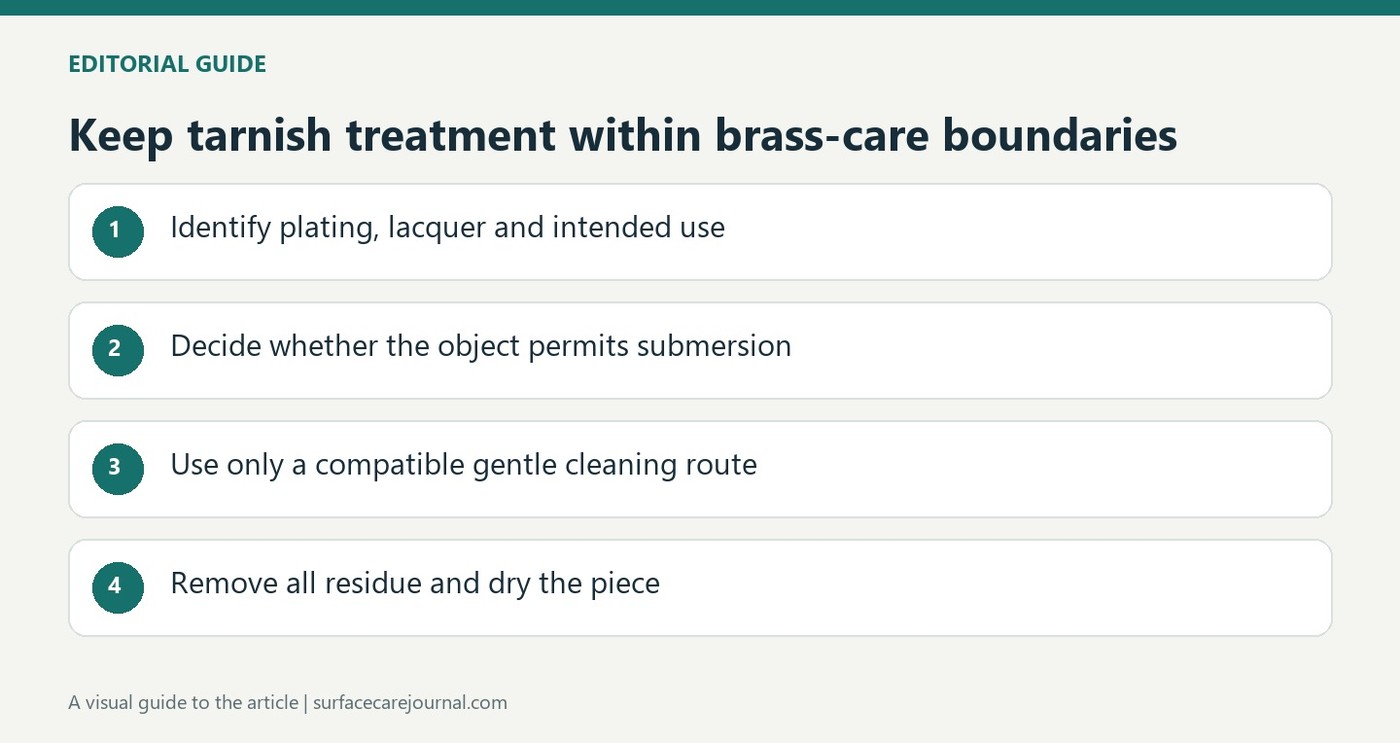
Check plating and protection first
The Spruce recommends determining whether an item is solid brass or brass-plated before trying to polish it. Thin plating can be worn away by excessive scrubbing, while lacquered brass should not receive the article's stronger tarnish-removal methods. If its protective coating is sound, warm soapy water can be enough for ordinary dust and grease. This initial distinction matters more than selecting a favorite household paste.
Remove the cleaner completely
For a suitable brass piece, the guide begins by washing away surface grime, either in a bath when submersion is allowed or with a soft damp cloth when it is not. Any compatible tarnish process is followed by thorough rinsing and drying with microfiber. A soft brush may reach detailed areas, but it should not become aggressive abrasion. Regular gentle care and cautious handling help maintain the result without repeatedly attacking a delicate finish.
Keep use and construction in the care decision
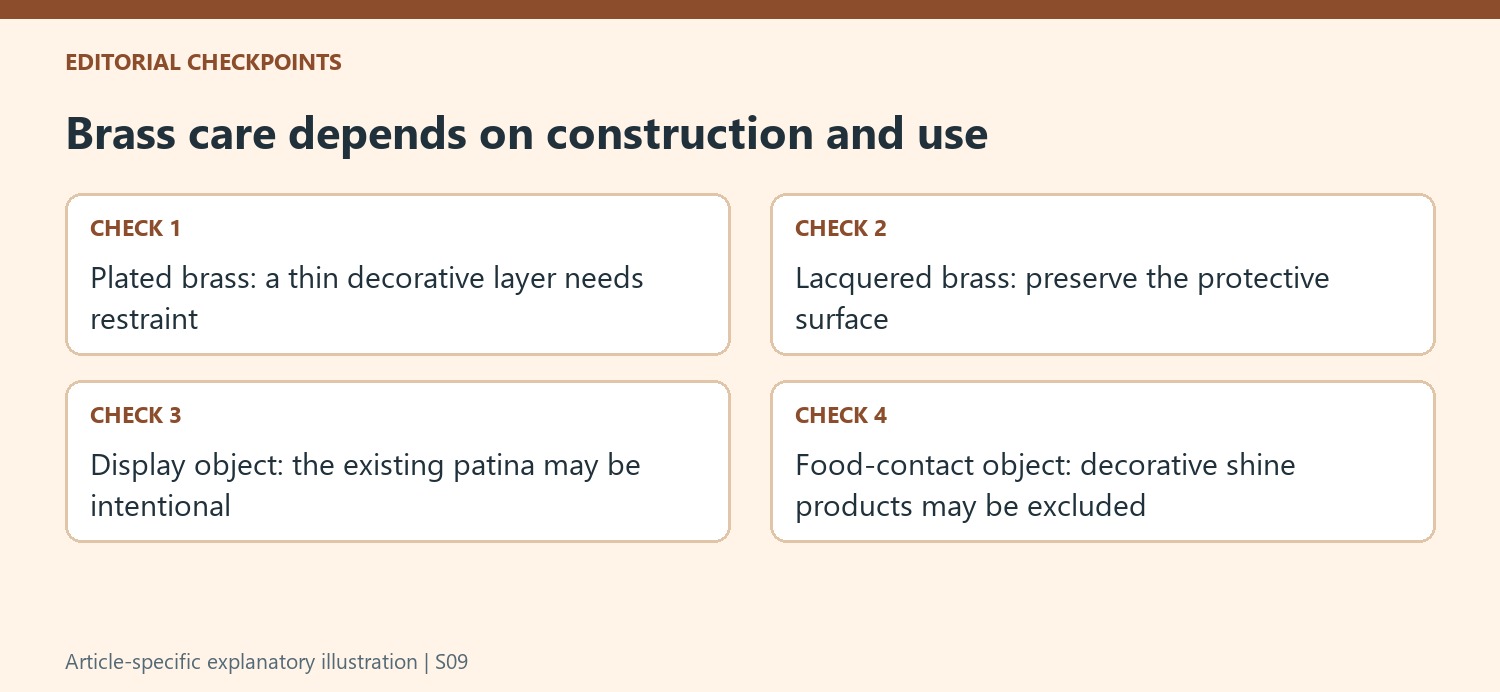
The Spruce's methods distinguish a loose object that can enter a wash bath from hardware or another piece that cannot be submerged. Brass-colored appearance alone does not answer that question. Its additional cautions also separate decorative polishing from food-contact use, explicitly excluding WD-40 on cookware and utensils. Preserve those boundaries instead of treating every shine-enhancing product as a cleaner for every brass item. Acids can darken brass when left too long, and thin plating can disappear under repeated abrasion. If the object's age, coating or construction is uncertain, identify it before selecting a recipe. Routine dust removal may be all that is needed today.
Keep the lacquer warning at the start of the decision
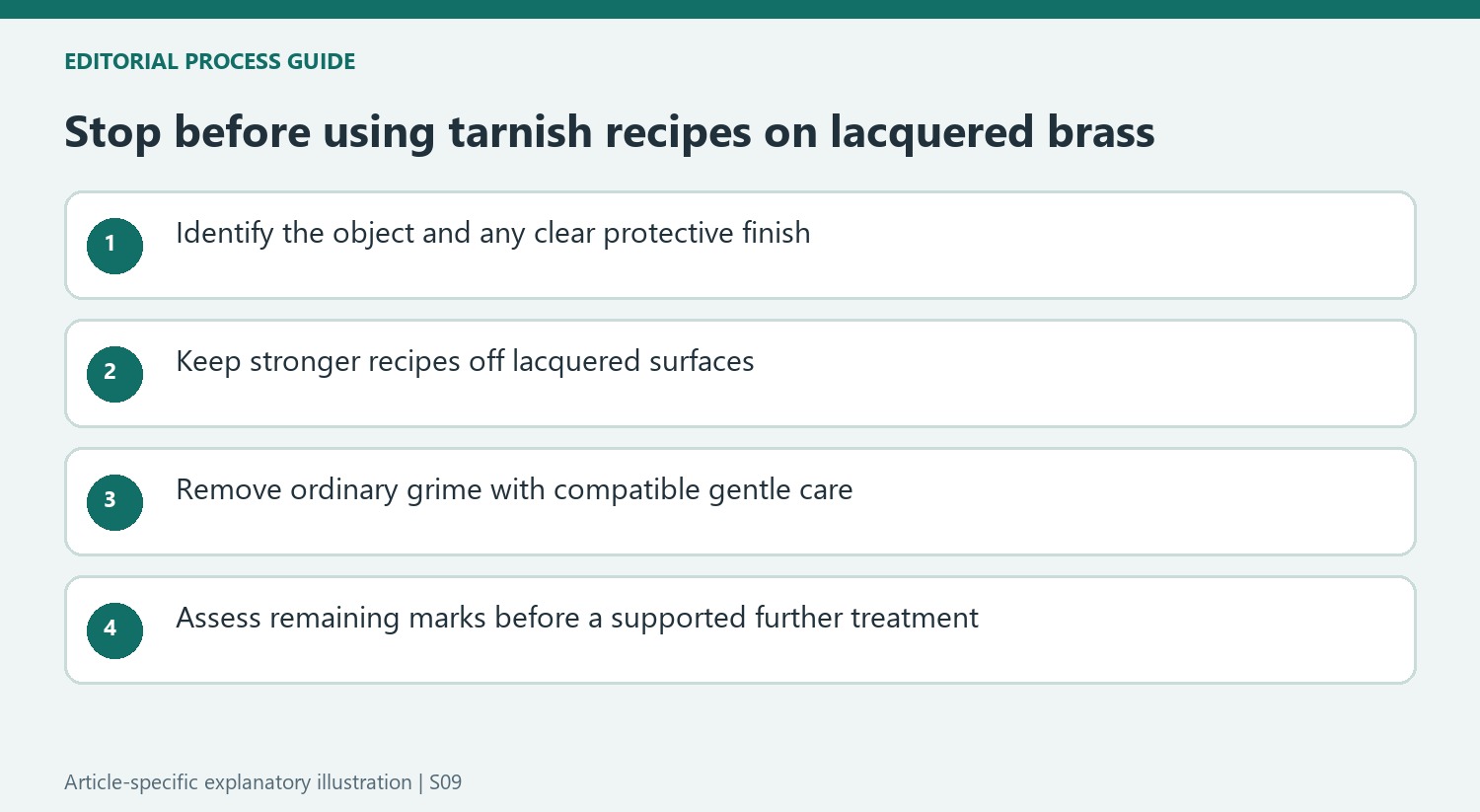
The Spruce states that its stronger tarnish-removal methods should not be used on lacquered brass. That restriction belongs before the recipe, not as an afterthought once ingredients are mixed. Find out whether the object has an intact protective finish and follow its own care instructions. A dark area on a coated piece can require a different assessment from tarnish on bare brass, particularly if the coating has already become worn or damaged.
The source also distinguishes solid brass from a thin brass layer over another material. A magnet can reveal some magnetic substrates, but it does not establish every possible construction when it fails to attract. Use the maker's information or expert identification for uncertain valuable objects. Scrubbing harder because an item looks like solid brass risks removing a thin decorative layer whose appearance was the very reason for cleaning it.
Remove ordinary soil before deciding that tarnish needs treatment
The guide's methods begin by clearing dust and grease with compatible mild washing. This initial step makes the later assessment more useful: some dullness may be ordinary soil rather than a need for acid or abrasion. For items that cannot be immersed, the article describes controlled wiping instead. Consider any attached materials, hollow spaces or electrical components before interpreting a general brass-cleaning instruction as permission to submerge the whole object.
Its household alternatives should remain separate options, selected only where the surface permits them. Familiar kitchen ingredients can still be acidic or abrasive, and a longer contact time is not automatically beneficial. The source itself warns that acids left too long can darken brass. Keep the applicable timing, removal and drying conditions together instead of remembering only the ingredient associated with a brighter result in the article's photograph.
Adapt the routine to contact and the purpose of the object
The source contrasts frequently handled hardware with decorative pieces that can remain undisturbed for months. That supports condition-based care rather than aggressive polishing at one fixed interval for everything. Dust compatible display pieces with clean soft material and limit unnecessary hand contact. After any supported wet process, remove residue thoroughly and dry before putting the object back, including details that might retain moisture or cleaning paste.
Keep food-contact use separate from decorative shine. The article explicitly excludes a lubricant-style shine suggestion from cookware and cooking utensils, illustrating why intended use matters. A polish suitable for a display object is not a universal brass treatment. Where a valuable item has uncertain coating, plating or patina, obtain specific advice before altering it. Gentle maintenance can preserve its current appearance without assuming that a newly bright surface is always the best conservation outcome.
References
- How to Clean Brass with 5 Simple Methods. The Spruce; Mary Marlowe Leverette.
The Spruce separates gentle grime removal from treatment meant for suitable uncoated brass pieces.


Leave a Comment
Comments (0)