Dishwasher Permission Depends on the Whole Stainless-Steel Item
Homes & Gardens explains that many stainless-steel items tolerate dishwashing, while heat and detergent can still cause marks or dulling. Manufacturer permission matters more than the metal name. A utensil with wood or plastic parts, or a painted or insulated bottle, may have restrictions that bare stainless steel does not.
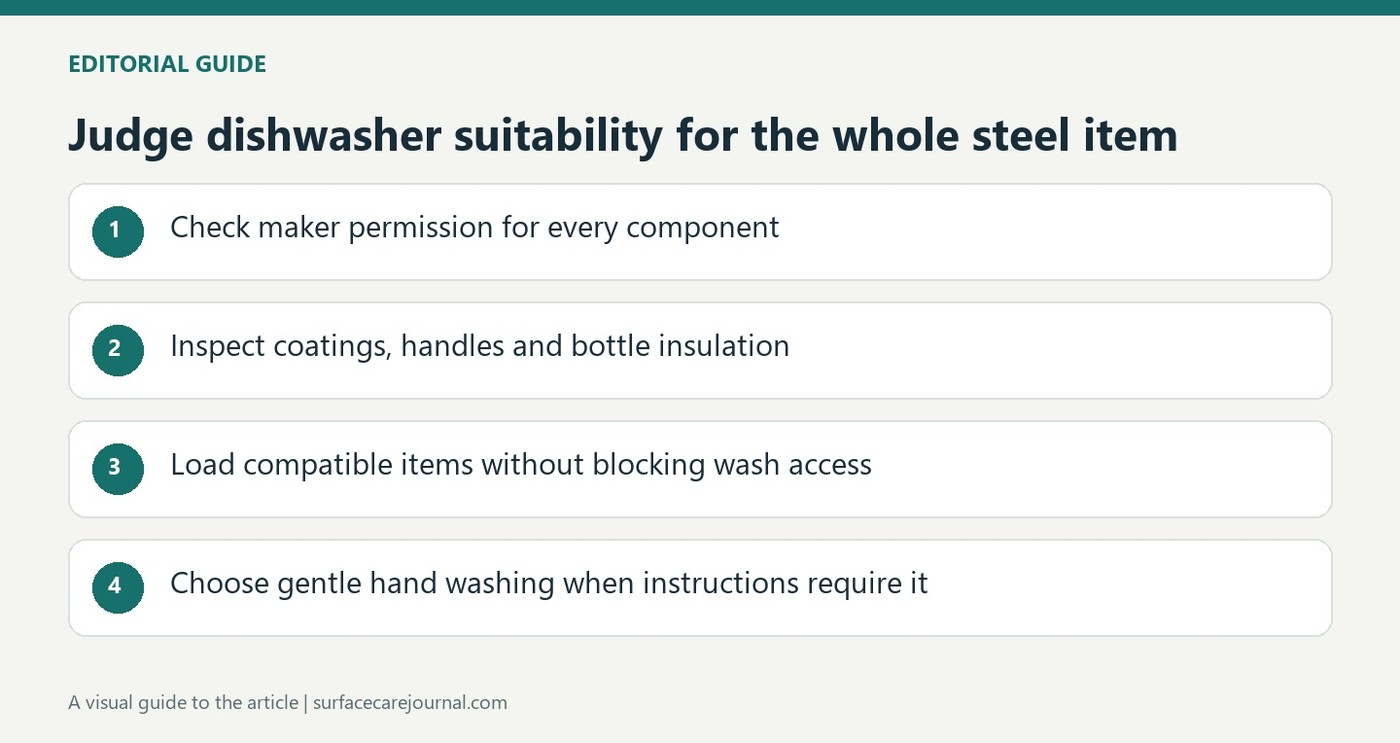
Remove food scraps and load compatible items according to the appliance guidance rather than packing them indiscriminately. Hand washing can offer more control for knives, decorative finishes and items whose instructions are uncertain. Treat a stainless-steel pan's coating and handle as part of the care decision; the construction must be suitable as a whole, not merely one exposed surface.
Check the entire construction
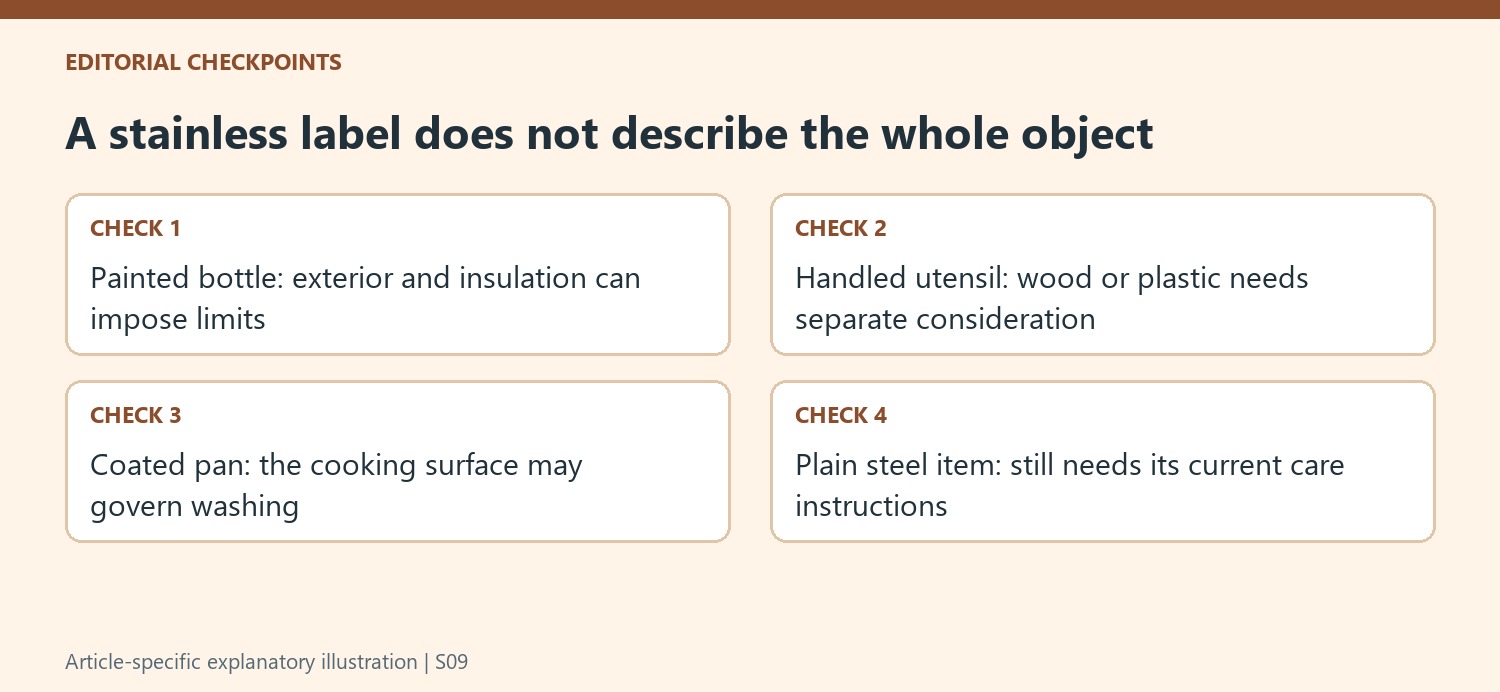
Homes and Gardens highlights utensils with wood or plastic parts and bottles that are painted or insulated. Those components can set limits even when an exposed stainless section tolerates dishwashing. A cookware base made from another metal or a nonstick interior also changes the decision. Look for the item's own dishwasher permission rather than assuming a familiar material name covers all its parts.
Load permitted pieces for cleaning access
The guide recommends removing food scraps and orienting cookware so the dirty area can be reached by wash water. Avoid packing compatible items so tightly that another pan blocks the spray or holds pooled water. Use the appliance's loading guidance for sharp tools and bulky pieces. Dishwasher permission does not remove the need for a suitable position and an unobstructed wash.
Use hand washing when more control is needed
The source presents warm soapy water and compatible soft tools as an alternative, particularly when protecting appearance or dealing with localized residue. Let cookware cool appropriately before washing and dry it after rinsing. Stronger stain products still need food-contact and finish compatibility checks. A hand-washed coated pan should not receive an appliance polish simply because the outer body is stainless steel.
Judge the complete object rather than the steel component
Homes & Gardens gives dishwasher use a qualified answer because stainless steel is only part of many household items. A water bottle can include insulation and paint; a utensil can carry a wooden or plastic handle; a pan can have a nonstick interior. Inspect the whole construction and find its maker's dishwasher instructions. Identifying one visible metal does not establish what repeated heat, water and detergent will do to everything attached to it.
The source's interviewed cleaners also distinguish dishwasher compatibility from preserving a preferred appearance. A permitted item can still show spots or dullness, so decide what outcome matters before loading. Do not interpret a broadly positive comment about steel as a guarantee for a coated knife handle, insulated bottle or exposed aluminum component. Product-specific directions settle those cases more reliably than the fact that another stainless object survived a previous wash cycle.
Prepare and load only the items whose instructions permit it
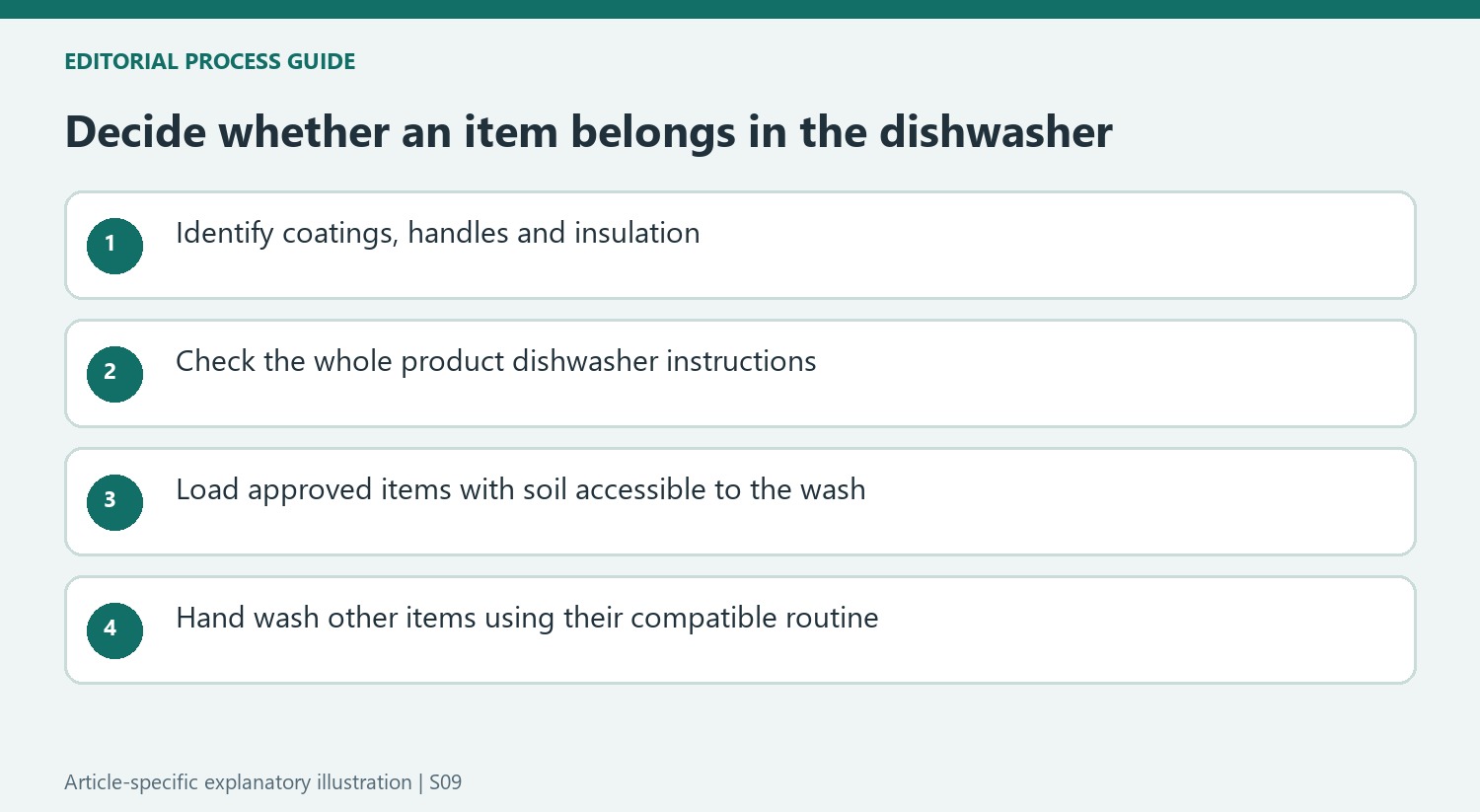
For approved cookware, the guide recommends clearing leftover food and arranging the soiled side toward the wash. Keep that preparation consistent with the dishwasher's own loading directions, including room for water access. A pan placed in a crowded rack may not clean well even if its materials are permitted. Dishwasher approval is therefore one decision; an arrangement that allows the selected cycle to reach the soil is another.
Do not use the machine as a substitute for identifying an unfamiliar coating. The article is particularly cautious about nonstick surfaces, while current cookware instructions should decide the exact item's route. Separate hand-wash items before the convenient end-of-day loading stage so they are not included by habit. This makes the material distinction actionable when tiredness otherwise encourages putting every pot, utensil and bottle into the same convenient load.
Choose hand washing deliberately when it offers better control
The source describes hand washing as a gentler alternative that allows attention to stubborn local residue. Let cookware cool appropriately, then use a permitted mild soap and nonabrasive tool under its instructions. Any soak must suit the entire object, including handles and coatings. The option to wash by hand is not permission to hold an insulated container underwater or transfer a bare-steel stain recipe to an attached material.
Other household cleaning suggestions in the article remain alternatives requiring their own approval, not a combined treatment. Remove cleaner thoroughly and dry as directed before putting the item away. Inspect the actual cooking or drinking surface as well as the polished exterior. A useful routine separates whole-object compatibility, effective soil removal and final appearance, allowing the dishwasher to be used where supported while preserving a clear route for items better maintained through controlled hand washing.
References
- Can stainless steel go in the dishwasher? Experts say yes, with caution – here's why. Homes and Gardens; Ottilie Blackhall.
Handles, coatings and insulation can change the care requirements of an otherwise durable metal object.


Leave a Comment
Comments (0)