Support Oven-Door Glass Before Cleaning Removable Panels
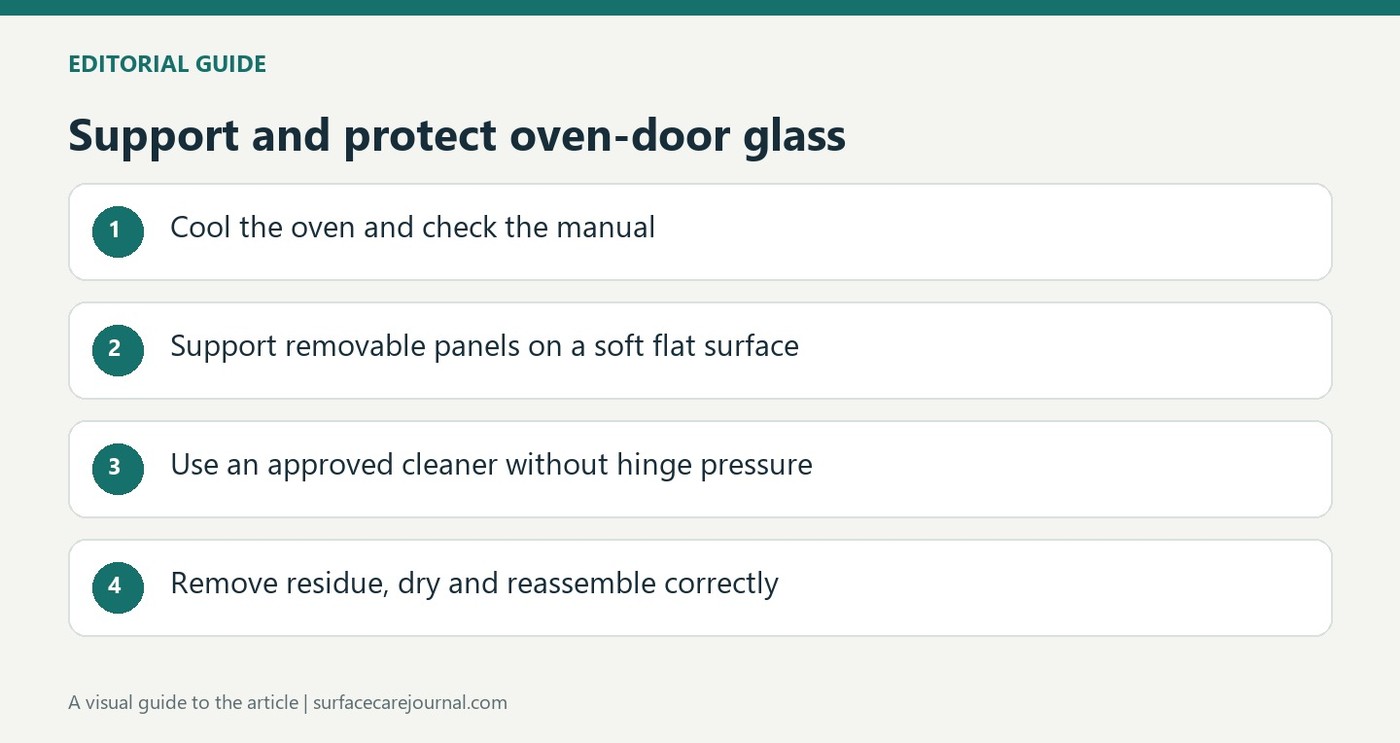
Ideal Home's glass-oven-door guide advises checking the manufacturer's instructions before removing panels. Some models allow removal for easier cleaning, while others do not. A removed panel needs a soft, flat supporting surface, such as a towel, rather than being placed where an edge could be chipped.
Let the oven cool and select a cleaner approved for its glass and coatings. When the door remains attached, avoid leaning heavily on it while scrubbing because the hinges are not a workbench. Regular attention to splashes helps prevent thick baked-on deposits, but stronger force is not a substitute for the correct product, support and handling procedure.
Distinguish light grease from baked-on deposits
Ideal Home explains that repeated oven heat hardens splashes into a layer that becomes harder to remove. On a cool appliance, light soil may lift with a damp cloth. Persistent material needs the manufacturer's supported cleaner and contact time, rather than more weight on the open door. Check any coating restrictions before using a paste or dedicated oven product.
Keep scraping conditional on the appliance guidance
The article discusses careful lifting of remaining residue with a suitable scraper, but it also warns about abrasive or overly strong products. Confirm that the oven manual permits the tool on that panel. Do not use a successful test on ordinary window glass as evidence for oven-door compatibility. If the correct treatment does not release a mark, seek advice rather than forcing the blade across the surface.
Finish both faces without flooding the assembly
The source treats the outer glass as a separate finishing task and recommends removing remaining moisture with a clean dry cloth. Keep water controlled so it does not enter places that are not meant to be washed. Accessible trim and knobs can collect dirt too, but remove components only when the manual allows it. Reassemble any removable panel according to the appliance instructions after cleaning and drying.
Decide whether the panel should move at all
Ideal Home begins with the appliance manual because some ovens allow a panel to be removed and others do not. Removal is a model-specific procedure rather than a routine step to improvise from a general guide. Establish the permitted method before releasing clips, trim or other components. If the door remains attached, its open position should not be treated as a sturdy table on which to lean while scrubbing a stubborn patch.
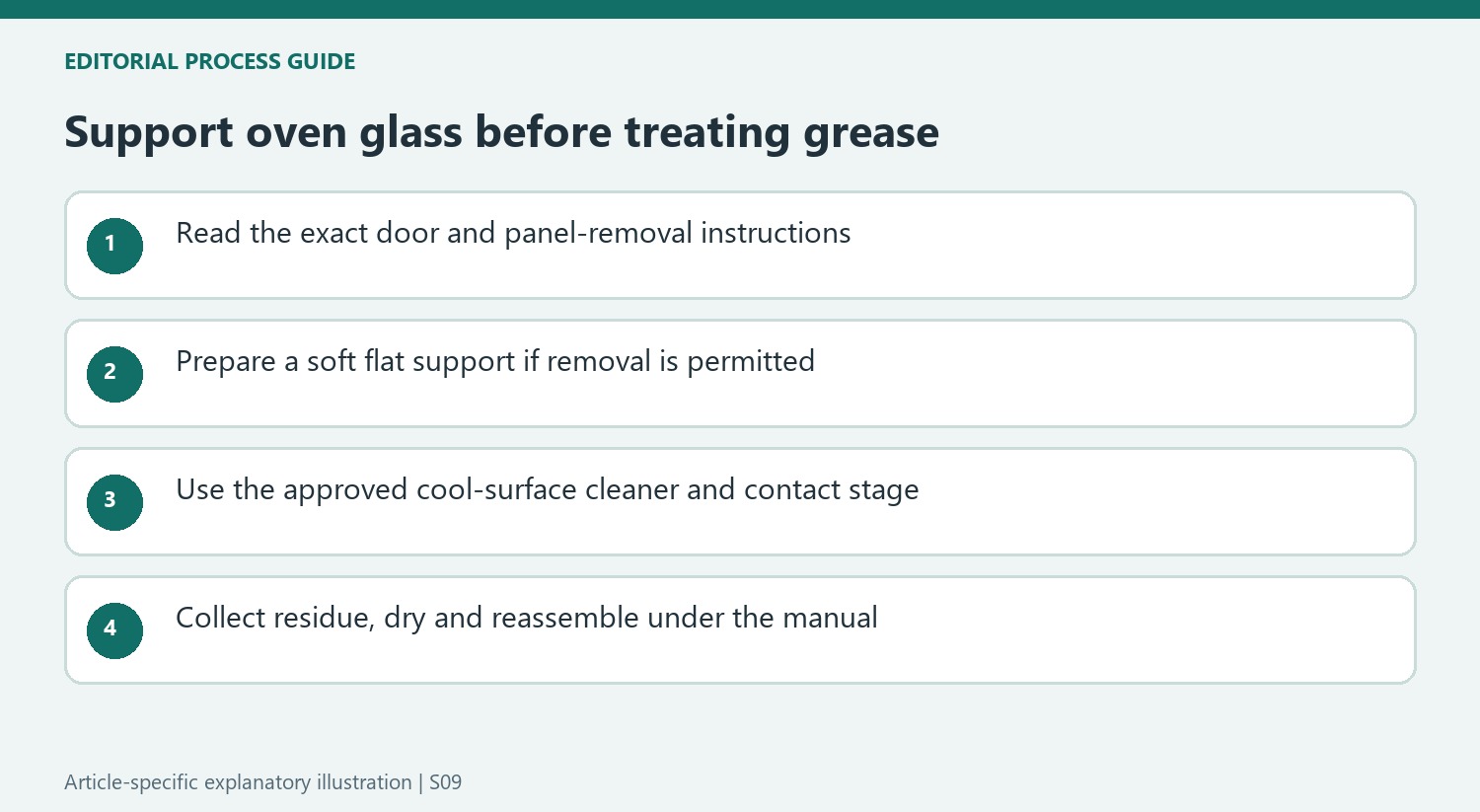
Where removal is explicitly supported, prepare the soft flat resting place before handling the glass. The source suggests a towel so the panel is not placed on an unforgiving edge or uneven surface. Use the manual's handling and reassembly sequence and keep the piece properly supported. An easier cleaning angle is useful only if the move preserves the panel and its fittings; unnecessary disassembly adds work without solving a cleaning problem.
Use time and compatibility instead of extra force
The guide describes grease becoming harder to remove as repeated cooking bakes it onto the pane. On the cooled appliance, start with the supported approach for the actual level of soil. A light film may not need the same treatment as a thick brown deposit. Allow the approved cleaner its stated contact stage instead of substituting vigorous pressure. Persistent residue is a reason to check the method, not to transfer body weight onto the door hinges.
The article presents several household alternatives, but those examples do not establish permission for every coating, detergent or scraping tool. Consult the oven instructions before selecting any of them. In particular, a scraper requires explicit suitability for that panel and controlled handling under the relevant guidance. Do not assume that success on a household window proves that an oven's inner glass can tolerate the same tool or abrasive material.
Finish the assembly as carefully as the pane
Collect the loosened grease and cleaning material with restrained damp wiping rather than flooding the door. The source warns about excessive water around the appliance. Keep liquid out of spaces not intended for washing and dry accessible surfaces as directed. Treat the outer glass as a distinct finishing area with its own approved product and clean cloth, so dirty inner-door residue is not spread across the surface touched during daily use.
Knobs and trim also collect dirt, but remove them only where the manual permits it. Refit any supported removable panel after it is clean and dry, checking that the prescribed retention is complete before the oven returns to service. Regular attention to new splashes on a suitably cooled appliance helps avoid another thick baked-on layer. The desired result combines a clearer viewing pane with sound support, correct assembly and removal of the cleaner itself.
References
- How to clean a glass oven door in 7 steps to remove grease, grime and burnt-on stains. Ideal Home; Emma Rinaldi; Jenny McFarlane.
The appliance manual determines whether the glass can be removed and how to handle it safely.


Leave a Comment
Comments (0)