
Spot-Treat Fabric Kitchen Chairs with a Compatible Product
The kitchen-chair reference notes that upholstered seats generally cannot be placed in a washing machine as a complete item. A fabric-safe commercial spot cleaner offers one possible response to localized marks. Product instructions determine the application and contact time.
Check the chair's care label and test a hidden section first. Some upholstery-cleaning equipment can help where the material permits it, but water and detergent still need control. Focus on the affected area without saturating the seat's filling.
Treat the seat as a constructed item
Homes and Gardens discusses fabric kitchen chairs whose upholstery is attached to a frame and padded insert. That construction makes whole-chair soaking a different proposition from washing a removable cover. Check the manufacturer before choosing a method, including whether a zippered cover is actually washable. Advice for one chair or stain should not be transferred to every foam cushion, adhesive or wooden frame.
Choose between local treatment and permitted extraction
The article quotes Michelle Hansen of Practical Perfection recommending a fabric spot product and a portable cleaner that can recover applied liquid. These are possible routes for compatible upholstery, rather than a reason to combine every treatment. Start with the label and a discreet test. Work gently with a suitable cloth or tool, and avoid aggressive scrubbing that could change the weave or finish.

Finish without leaving a damp core
Remove cleaning residue according to the selected product's directions and use clean cloths as they become soiled. Where extraction is permitted, the recovery step matters because introduced water can remain in the seat padding. Give the chair enough airflow and time to dry before putting it back into everyday use. Inspect the dry result before repeating treatment; a wet patch can obscure both residue and color change.
Treat the upholstered seat as an assembly
Homes & Gardens points out that a fabric kitchen chair cannot simply be placed in the washer as a complete item. The visible covering may be fixed over padding and joined to a wood or metal frame. Check the care information for that construction before deciding how much liquid or heat it can receive. Kitchen use increases the chance of food marks without making the seat inherently resistant to cleaning chemicals or prolonged soaking.
If a cover can be opened, confirm whether it is actually washable rather than inferring permission from a zipper. Fabric, insert, adhesive and frame finishes can impose different limits. Identify the affected area and collect accessible crumbs before applying a product. Loose debris removed first will not be pressed through the weave during the later damp stage, making a local stain treatment easier to assess without turning the whole seat into a wet cleaning surface.
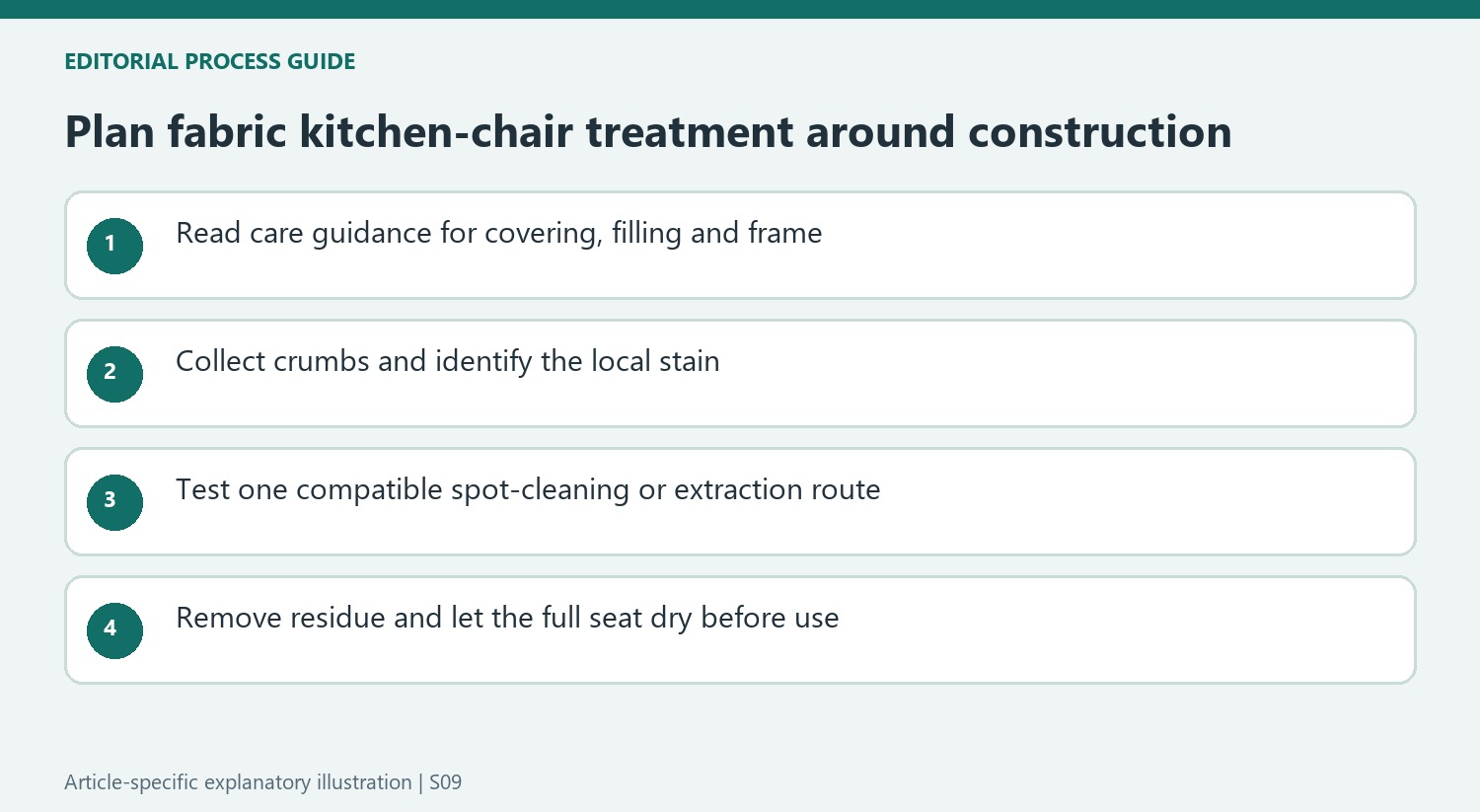
Select a compatible local method before extraction
The source quotes an expert recommending a fabric spot cleaner and also discusses a portable machine that recovers liquid. Treat these as possible routes for approved upholstery, not automatic permission to combine products. A spray suitable for hand cleaning may not be an accepted machine formula. Read the current labels and equipment manual, then use a hidden-area test and the furniture maker's supported process to decide what can contact the seat.
Apply a compatible product in controlled amounts and follow its stated contact and removal directions. Work with a suitable cloth or gentle tool rather than escalating to forceful scrubbing because the stain remains visible while wet. Repeated friction can alter the weave or finish. The source's broader household suggestions should not be transferred into whole-chair soaking where construction guidance does not permit it, even if that sounds quicker than a careful local treatment.
Make the filling's dryness part of the result
Cleaning the fabric face is only one stage if moisture has reached the cushion beneath it. Where extraction is explicitly permitted, follow the recovery technique and avoid repeated application without useful collection. For a cloth-based process, refresh the working face as it becomes dirty and remove cleaner under the approved directions. A wet shine or temporarily lighter mark does not establish that detergent and soil have left the material.
Give the chair suitable airflow and enough time to dry before it returns to everyday seating. Inspect the dried fabric for an outline, residual mark or texture change before selecting any repeat treatment. A kitchen schedule should allow that wait rather than rushing the chair back to the table because dinner is ready. The useful routine responds to the actual spill and construction with controlled cleaning, complete removal and drying, preserving the seat instead of relying on one universal wash for every upholstered stool or chair.
References
- How to clean fabric kitchen chairs – expert solutions for a spotless finish, fast. Homes and Gardens; Megan Slack.
Fixed upholstery needs a controlled approach rather than the treatment used for washable covers.


Leave a Comment
Comments (0)